What Happens When People Think You Won’t Stop Them?
Did you know there was an experiment in 1974? And what happened can tell us something uncomfortable about what happens when people think there are no consequences for crossing a line.

By Clara Elise
Wellness Writer & Educator
1 Oct 2026·6 min read

In this article
It happened in Naples, Italy.
A young performance artist named Marina Abramović stood completely still inside a gallery.
She would not speak.
She would not move away.
Beside her was a table containing 72 objects.
Some were harmless: a rose, grapes, honey and a feather.
Others were not.
There was a knife. A scalpel. A whip. A gun. And a bullet.
The people present were told they could use those objects on Marina however they wanted.
For the next six hours, Marina would not stop them.
At first, people were gentle. They gave her flowers. They touched her carefully. Nothing particularly disturbing happened.
Then people began to realize something.
She wasn’t going to stop them.
And that’s when the atmosphere changed.

Then people started testing how far they could go
As the hours passed, the behavior became more aggressive.
Her clothes were damaged. Her skin was cut. At one point, a loaded gun was placed against her, with her own hand positioned near the trigger.
What had started with flowers and curiosity had become genuinely dangerous.
Marina still didn’t respond.
Then the six hours ended.
She moved.

For the first time, she began walking toward the same people who had been standing around her.
And something strange happened.
They backed away. Some headed for the door.
People who had been willing to do almost anything while she stood there passively suddenly didn’t want to face her once she became an active person in front of them.
The people hadn’t suddenly changed.
The situation had.
Now think about something much smaller
Your life obviously isn’t an art gallery. Most boundary problems are nowhere near as extreme as Rhythm 0. And this performance was not a scientific experiment proving why people behave badly.
But it leaves us with an uncomfortable question:
What happens when someone crosses a line and discovers that nothing seems to change afterward?
A friend makes a joke about you that you genuinely dislike. You laugh because you don’t want to make things awkward. So they do it again.
A family member calls whenever they need something. You’re exhausted, but you answer anyway. Eventually, your availability starts to feel expected.
Your manager gives you something at 4:55. You stay late and finish it. A few days later, another urgent task lands on your desk at 4:55. Guess who they ask again?
Small moments can quietly become expectations.
None of this means you caused somebody else’s behavior. But repeated interactions give people information about how a relationship works.
Sometimes they genuinely don’t know where your limit is. Sometimes a pattern has developed around you always accommodating them. And sometimes they understand the limit perfectly well and choose to ignore it anyway.
Those are very different situations. Knowing which one you’re dealing with matters.
But how do people know where your line is?
You may know exactly what bothers you.
I don’t like when she talks about my relationship in front of other people.
I don’t want work messages late at night.
I don’t want to lend money again.
But the other person may not know where that line is.
Healthy relationships don’t need a rulebook for every interaction. But when something repeatedly makes you uncomfortable, silently hoping the other person will eventually figure it out often doesn’t work.
A useful boundary usually involves three things: you notice your limit, you communicate it clearly, and you follow through if the situation continues.
That last part matters, because a boundary isn’t simply asking another person to behave differently. It also tells you what you will do if the situation continues.
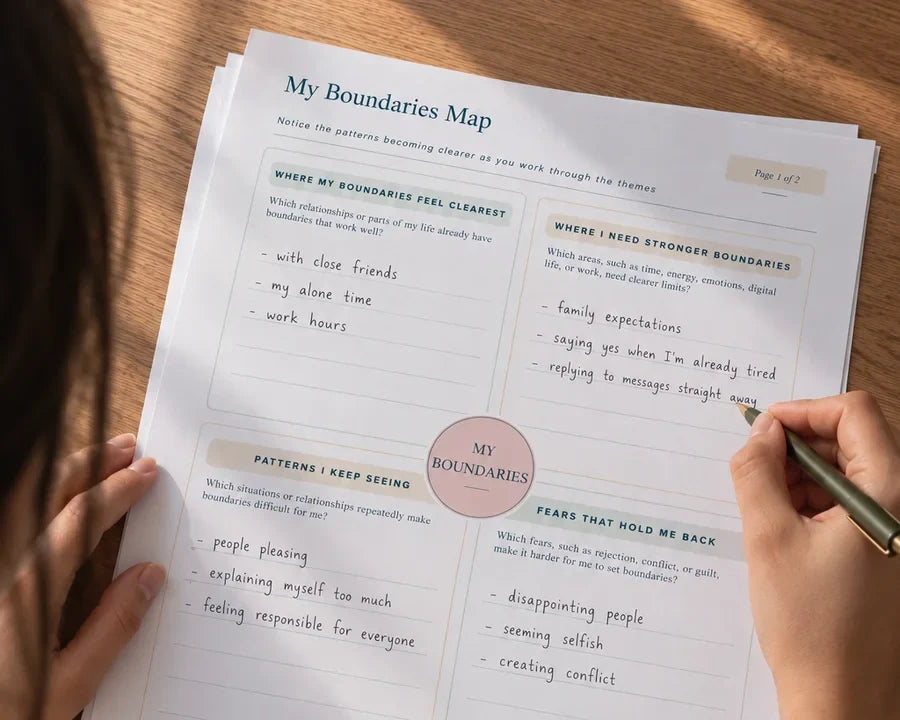
If you’d like to work through this on paper, The Boundaries Workbook walks you through it step by step, with 108 prompts to help you notice your patterns and hold your limits.
So what does a real boundary actually sound like?
Instead of: “Don’t message me after 10.”
Try: “I don’t usually respond to non-urgent messages after 10. I’ll reply tomorrow.”
Instead of: “Stop shouting at me.”
Try: “If we’re shouting, I’m going to pause the conversation and we can come back to it later.”
See the difference?
The first asks someone else to change their behavior. The second makes your own response clear.
That doesn’t make the boundary rude or dramatic. It simply makes the line visible.
But here’s where a lot of boundary advice gets it wrong
You’ve probably heard some version of this:
“People only disrespect you because you allow them to.”
That’s too simple.
You can communicate a boundary clearly. You can repeat it calmly. You can follow through consistently. And another person may still decide to cross it.
Their behavior is still their choice.
Boundaries aren’t magical instructions that make everyone respectful. Sometimes their biggest value is that they give you information.
Imagine you say, “I don’t want you joking about that anymore.”
One person might say, “I didn’t realize it bothered you. I’m sorry.”
Another might say, “You’re too sensitive. I’ll joke about whatever I want.”
Both responses tell you something.
The boundary didn’t fail. It revealed the relationship more clearly.
So what if they keep doing it anyway?
Sometimes people don’t dislike the boundary itself. They dislike what changes because of it.
Maybe you’ve always been the person who answers immediately, changes plans and almost never says no.
Then one day you say, “I can’t today.”
For you, it’s one small sentence. For someone who became comfortable with your constant availability, the relationship suddenly feels different.
That doesn’t automatically make them a bad person. They may simply need time to adjust. But what happens next tells you something.
Do they accept your no? Do they negotiate respectfully? Or do they guilt you, pressure you or act as though your availability belonged to them?
You can be generous and still have limits. You can compromise and still say no. The goal isn’t to stop giving. It’s to make your yes something you choose, rather than something you’re afraid not to give.
If someone keeps crossing the line, ask: Have I made the limit clear? Have I followed through consistently? Do they understand the boundary and keep ignoring it? What will I do if it happens again?
Sometimes the answer is better communication. Sometimes it’s more consistent follow-through. And sometimes it’s accepting that another person is unlikely to respect the limit no matter how carefully you explain it.
At that point, the question changes from “How do I make them understand?” to “How much access do I want this person to have to my time, attention and energy?”
What Rhythm 0 leaves us with
Marina Abramović’s performance was extreme. Everyday boundary problems usually aren’t.
But more than fifty years later, one part of the story still feels uncomfortable.
For six hours, Marina remained passive while other people decided what happened next.
Then the performance ended.
She moved toward them.
And suddenly they had to face her.
Maybe that’s the part worth remembering.
A boundary isn’t about controlling other people. It isn’t about punishing them. Sometimes it’s simply the moment you stop silently accepting what is happening and make your position visible:
This is what I’m okay with.
This is what I’m not okay with.
And this is what I’ll do if that line is crossed.
You are not an object in somebody else’s story.
You get a say in how people have access to you.
If you’re not sure where your own boundaries are
Knowing that you need boundaries is often easier than knowing where your limits actually are, what to say, or what to do when somebody pushes back.
That’s what the BetterWithClara Boundaries Workbook is designed to help you work through: recognizing your limits, understanding why saying no can feel uncomfortable, practicing clearer communication, and deciding what healthy follow-through can look like in real relationships.
You don’t need to become harder. You may just need to become clearer.
Source: MoMA — Marina Abramović, Rhythm 0, 1974

This article is for general self-reflection. It isn’t medical, psychological or other professional advice.